
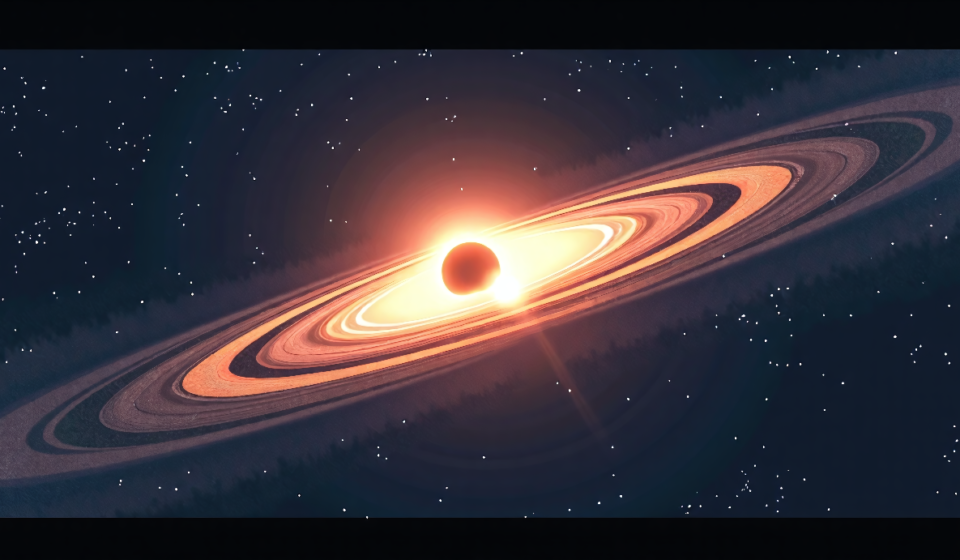
Astronomers Spot ‘Black Hole Star’ – A Stellar Powerhouse 100 Billion Times Brighter
Astronomers Spot ‘Black Hole Star’ – A Stellar Powerhouse 100 Billion Times Brighter
In a surprising new study, astronomers have identified an object that resembles a star the size of our solar system yet radiates an astonishing 100 billion times more energy than any known star. Dubbed a “black hole star,” this discovery challenges conventional models of stellar evolution and opens fresh questions about the universe’s most extreme phenomena.
What Is a Black Hole Star?
Unlike a traditional star, which generates light through nuclear fusion, the newly found object appears to be a dense, compact body that emits energy at a rate far beyond typical stellar output. Its size is comparable to the Sun’s orbit, but its luminosity is orders of magnitude greater, hinting at an exotic energy source—possibly a form of accretion or a previously unknown type of compact object.
How Was It Detected?
Using a combination of optical telescopes and radio arrays, researchers observed a bright, red dot that did not match any cataloged star or galaxy. Follow‑up spectroscopy revealed a spectrum with unusual emission lines, suggesting a highly energetic process at work. The object’s brightness and size were confirmed through parallax measurements and infrared imaging.
Implications for Astrophysics
If confirmed, a black hole star could represent a new class of celestial bodies that bridge the gap between massive stars and black holes. Its extreme energy output might be powered by rapid accretion of surrounding material or by exotic processes such as dark matter annihilation. The find could also provide a natural laboratory for testing theories of gravity under extreme conditions.
Next Steps in Research
Scientists plan to monitor the object across multiple wavelengths, including X‑ray and gamma‑ray observations, to better understand its emission mechanisms. Detailed modeling will help determine whether the energy output can be explained by known physics or if it points to new physics beyond the Standard Model.
For more details, read the full CBS News report: Black Hole Star Discovered: Mystery Red Dots.
Watch and listen free on JASTORM – Follow radio and video broadcasts free in the JASTORM app with your free account.