
The NCAA begged Congress to fix its problems. Now it's paying the price as Washington politics take over.
The week began with legitimate hope that the Protect College Sports Act would be on a glide path toward becoming law, with a supermajority of support in the U.S. Senate and momentum to land on President Donald Trump's desk.
It ended in a place college sports has found itself time and time again over the last seven years in its dealings with Congress: mired in the nuts and bolts of American politics.
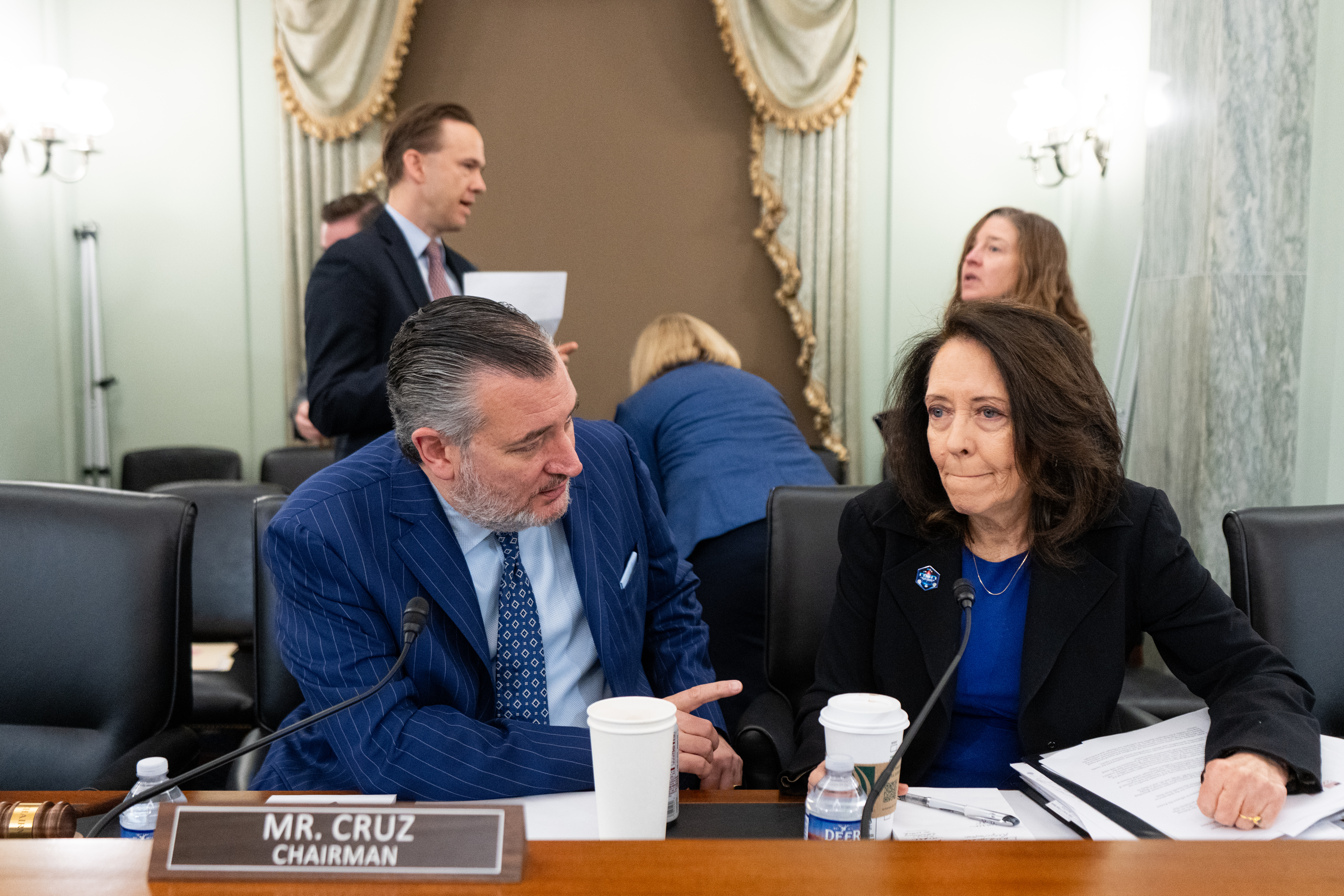
As Yahoo Sports colleague Ross Dellenger reported deep into Friday night/Saturday morning, the bill is now in legislative purgatory as the Senate heads into its August recess. Instead of being jammed through without a lot of scrutiny, which seems to be what co-authors Ted Cruz and Maria Cantwell intended, the PCSA is now riddled with amendments and objections and various outside groups imploring senators not to pass it.
Progress has been halted. There are major questions about whether it can pass in any form. And when legislative work resumes in September, with midterm elections looming, there's no guarantee the Senate will even have the bandwidth to make it a priority.
Because the bill is not dead yet, and could potentially get a vote when the Senate returns from recess, it might be a tad early for the "I told you so's." But those of us who predicted the congressional gambit would be a dead end for college sports are starting to stretch and warm up for our victory lap.
Not because there's joy in college sports continuing to operate without enforceable rules but because this was all so foreseeable when the NCAA first started lobbying Congress seven years ago.
In December of 2019, former NCAA president Mark Emmert stood in the middle of a New York hotel and told a group of reporters that Congress was the only answer to various state legislatures starting to change their laws, which forced the NCAA to legalize NIL.
"It's complicated, but they also know there's a sense of urgency," Emmert said. "They're keenly interested in trying to have college sports be successful. There's a keen interest in trying to help us modernize the rules and create a framework within which this all continues to work in that direction. I think there's a lot of good intention and goodwill there."
Again, this is nearly a seven-year-old quote. And though Emmert has been replaced with Charlie Baker — hired specifically because of his government background and connections as a former governor of Massachusetts — both the rhetoric and the roadblocks are exactly the same now as they were back then.
Though NCAA officials and university presidents may believe they have allies in Congress who want to fix their problems, expecting Congress to actually do something ignored the underlying reality of our system.
When you ask for a political solution, you will get politics whether you like it or not.
And what do you know? Just when it seemed like the PCSA was headed for a floor vote, politics happened in a big way.
Three Republican senators filed an amendment to cram some language in the bill to make quadruple sure transgender athletes can't play college sports anymore — a completely unrelated issue to what the bill is supposed to do. Another Republican senator, Louisiana's John Kennedy, lodged an objection and was making noise about adding a provision to cap ticket price increases. Ashley Moody, a senator from Florida, filed an amendment that would exempt two schools in her state, Florida State and Miami, from the provision of the original bill that called for a mandatory five-year period of independence if they went from one power conference to another. More amendments are expected in September.
The Congressional Black Caucus is now opposing the bill, saying it can't support "federal protections and legal certainty to powerful athletic institutions while these same institutions remained largely silent as Black voting rights and Black political representation came under unprecedented attack."
Even a so-called bipartisan bill is getting pummeled from the left and right.
For better or worse, this is the American system. Its strength is that everyone gets a say on a piece of legislation like this. That's also its weakness.
Every amendment serves someone's political agenda. And every amendment makes the bill fatter and more complicated, risking more opposition.
That's why, when SEC commissioner Greg Sankey says college sports has "nonpartisan issues that deserve a nonpartisan solution," sometimes you wonder what planet he's living on.
Unregulated NIL and unfavorable eligibility rulings are inconvenient for college sports, but they are not a national emergency. When something really matters in Washington, one side eventually gives in and things get done. The luxury items usually just become background noise for the circus that helps politicians create social media clips and raise money for their next campaign.
A comprehensive college sports bill with more than 100 pages, creating regulations in areas where the federal government doesn't belong, was not the right strategy.
Sen. Tommy Tuberville, the former Auburn/Texas Tech/Cincinnati football coach, had it right. He advocated for a skinny bill that would simply give the NCAA protections to manage transfer portal rules and player eligibility without getting sued.
In conversations with a dozen or so football and men's basketball coaches over the last few weeks, they all agree that if the NCAA simply had the authority to regulate those two areas without various local judges involved in individual cases, 80 percent of the issues plaguing college sports go away. Maybe more.
Instead, the PCSA tries to do far more than that — too much, really. You don't need the government to make a law about when coaches can leave their current jobs. You don't need the government telling conferences how many members they can have. You certainly don't need the government setting a salary cap because it's not even clear that would hold up as constitutional without having athletes at the table to collectively bargain.
You just need to empower the NCAA to regulate transfers and make its own eligibility rules. That's really it.
Instead, the bill is a bloated, Frankenstein creation with no momentum. And while it sits on the shelf for the next five weeks, there's no telling what might happen in America or the world that will demand more immediate attention when Congress returns.
For decades, NCAA leaders were wary of federal involvement in college sports. Seven years ago, they begged for it.
Now, as their bill gets picked at to death, they're getting exactly what they signed up for.