

Fantasy Football: Pros and cons for the most popular draft strategies for 2026
If I'm with my wife and friends, the same sequence of events occurs. We go through the small talk. Update each other on our kids, parents, jobs — you know, the basics. But, ultimately, the conversation lands on football, and I can feel my wife's eyes glaze over. And she's told me multiple times that watching the sport is fun. However, discussing the fantasy side of it sounds complicated.
Join or create a Yahoo Fantasy Football league for the 2026 NFL season
I get it, though. We use so many nicknames, acronyms and phrases laced with sarcasm (“RBs Don't Matter!”) that you'd need a translator to figure out what we're saying and something akin to “The Silmarillion” to understand how they came to be.
Draft strategies are no different. So, to help, I've pulled together some of the latest and broken them down into what they are and how we can apply them ahead of the 2026 fantasy football season.
The Balanced Approach
What is it?
I'm going to add to the jargon when describing a balanced approach. It's a meat-and-potatoes strategy. In other words, we're focusing on the essentials of building a fantasy team. And if you're unfamiliar with the vital components of a roster, let's look at a basic lineup:
QB: 1 (# of starters)
RB: 2
WR: 3
TE: 1
Yes, I'm missing a FLEX, but you can see where the bulk of our needs reside. Every week, we have to start a minimum of five RBs and WRs. Bump that to six with a FLEX. Accordingly, a balanced strategy builds around those positions to open their draft. For instance, if you've got the 1.04, your first six picks could follow a similar path:
RB: Kyren Williams (3.04), D’Andre Swift (5.04)
WR: Puka Nacua (1.04), Nico Collins (2.09), Ladd McConkey (4.09), Christian Watson (6.09)
Can I win using this?
Unfortunately, I've seen people who've auto-drafted their team and won. So, yes, you could win by following this idea. Anyway, don't take my word for it. We can look to historical data to emphasize my point:
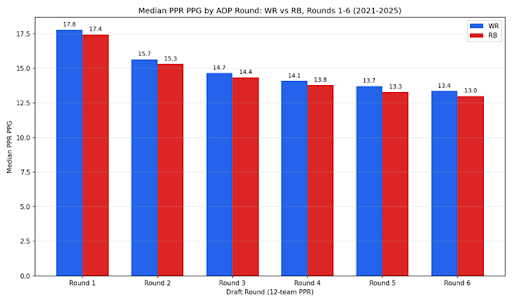
ADP isn't a product of jersey sales. Well, kind of. Hype, highlights, production and touchdowns are the real factors. But the market reflects popularity and talent. In other words, if you want a good player, you'll have to pay for them. So, taking as many chances in the early rounds on the positions we need the most is a sure way to have a strong roster that'll get you through the season.
Any pitfalls?
There's an old cartoon where the main character is trying to plug holes in the side of a ship. As soon as they cover one or two, another appears. All draft strategies have this problem.
Round 2: 22.0 (QB PPG), 13.2 (TE PPG)
Round 4: 19.2, 11.8
Round 6: 17.6, 10.9
While you're fixing your "RB and WR holes," a "QB and TE" gap is widening. The chance of you landing a no-doubt weekly starter dwindles as you fill up your core spots. So, you'll need to have a separate plan for the onesie positions to keep your team in contention.
Zero RB
What is it?
Surprisingly, Zero RB is as simple as it can be confusing. The easy description is: avoiding the RB position during the early rounds. On its face, anyone can put that idea into practice. But then you wind up with rosters carrying 11 WRs, a QB and/or TE selected in rounds 10 or later, and a smattering of RBs. So, let’s add a layer of nuance.
(2021-2025) Rounds 1-5: 2.9 (Avg. WR Reclamation Rate), 1.9 (Avg. RB Reclamation Rate)
Rounds 6-10: 2.8, 2.1
I went back over the last five seasons and found how often a WR1 or RB1 fell behind their teammates throughout the year. I disregarded one-week blips and looked for extended dips in opportunity. A WR drafted in the first five rounds “reclaimed” the top spot 2.9 times as compared to their RB counterparts (1.9). Zero RB aims to bypass the potential for injuries or shifts in workloads by waiting until the associated opportunity cost drops. Let’s look at a few examples from last season:
Cam Skattebo: 41.4 (2026 ADP)
Travis Etienne Jr.: 42.3
TreVeyon Henderson: 57.9
All three gave you RB1 weeks, with Henderson being the only rusher out of the trio to end the season inside the top 24 by PPR PPG. Their highs from ‘25 are the genesis of this season’s ADP. But think of their results from a week-to-week standpoint. Skattebo missed time due to injury, Etienne played on a Jaguars team that needed half the season to find their stride, and Henderson performed best without Rhamondre Stevenson active.
By banking on later RBs giving us comparable production, we can amass high-end talent at WR.
Can I win using it?
Earlier this week, I outlined the idea of positional hit rates. The main takeaway was that for RBs, we should lean into uncertainty deeper into the draft.
(2021-2025) Rounds 7-9: 36.0% (hit rate – exceeding draft cost by at least three spots)
Rounds 10-12: 39.0%
Rounds 13-15: 47.1%
Of course, we’re looking for RB1 results. Going from the RB20 to the RB17 isn’t going to move the needle. But the chance of us finding that archetype of player, with the path to a top-tier workload, picks up. The New England backfield I just mentioned offers a clear illustration based on last year’s data:
Rushing Rate (playoffs): 61% (Stevenson), 32% (Henderson)
Route Rate: 55%, 25%
Goal-line Share: 100%, 0%
As soon as Stevenson was healthy, he regained his job as the starter. But there’s a two-round difference in draft cost between the two RBs. By evaluating the situation, we can find the value in avoiding the risk of a split backfield early and reap the benefits later.
Any pitfalls?
We’re making bets that a situation will change during the season. But let’s see what happens if they don’t:
Projected Starter: Bhayshul Tuten (190.6 – PPR points), Kyren Williams (212.9)
Projected Backup: Chris Rodriguez (95.7), Blake Corum (139)
You could throw the Broncos, Commanders and Texans backfields into this conversation, too. But if Rodriguez doesn’t close the gap on Tuten, instead of getting RB2 output, we’re down to just inside the top 50. Corum’s RB35 value won’t even get us to the playoffs. In short, if you employ this method, you’re swinging for the fences without even knowing if you’ll make contact with the ball.
Hero RB
What is it?
If your conclusion after reading about Zero RB was that it’s intriguing but too risky, you’re in luck. Hero RB might be for you. I’ll demonstrate:
Round 1: Amon-Ra St. Brown (1.08)
Round 2: Drake London (2.05)
Round 3: Tee Higgins (3.08)
Round 4: Colston Loveland (4.05)
I tossed in a TE for this Zero RB build as the tack does allow for detours at the onesie positions. Anyway, instead of adhering to the technique, I make a slight adjustment.
Round 1: Amon-Ra St. Brown (1.08)
Round 2: Derrick Henry (2.05)
Round 3: Tee Higgins (3.08)
Round 4: Colston Loveland (4.05)
Now, as I’ve often said, don’t focus on just the name. Prioritize the profile. Henry has had rushing rates of 67% and 65%, respectively, since joining the Ravens, and almost 90% of the goal-line carries. He’s their bellcow. Anchoring an RB like him to your roster alleviates some of the pressure of hitting on an RB in the later rounds.
Can I win using it?
I used the same 2021-2025 data set and sliced it a different way to see where we typically drafted the best RBs:
2021: 12.1 (avg. ADP for the top 3 RBs)
2022: 18.4
2023: 24.0
2024: 9.0
2025: 4.9
Over the last five years, at least one of the eventual top-three RBs had a first-round ADP. On the one hand, it proves us right for keeping their draft price high. But, on a macro scale, by valuing concentrated workloads in positive ecosystems, we can partially address the RB position while still having WRs as the strength of our roster.
Any pitfalls?
Like Zero RB, not taking the nuance of the strategy into account can result in suboptimal results. I’ll make another tweak to the roster from earlier.
Round 1: Amon-Ra St. Brown (1.08)
Round 2: Brock Bowers (2.05)
Round 3: Tee Higgins (3.08)
Round 4: Bucky Irving (4.05)
The components of Hero RB are there. I only took one RB. I’ve got two strong WRs and an elite TE en tow. But compare Irving’s situation to Henry’s. Map out their paths to being in the top three by season’s end. Irving has more obstacles in his way. Said another way, there are diminishing returns on the strategy’s ability to pay off the longer you wait to grab your RB1.
Late-Round QB
What is it?
Actually, in other circles, Late-Round QB is a “who,” not a “what.” Regardless, the approach analyzed and popularized by JJ Zachariason has only grown in appeal when considering this year’s crop of QBs.
QB13: Brock Purdy, 4 (weeks with a top-12 finish in 2025)
QB14: Matthew Stafford, 10
QB15: Bo Nix, 6
Let’s say you’re one of those people who apply the Balanced Approach and forget to draft a QB. Even worse, a few of your leaguemates have taken a backup passer. No problem. The three signal-callers with ADPs outside of the top 12 had multiple QB1 weeks last season. And they’re not the only ones.
Jared Goff (QB17) had seven games with a top-12 finish, including a couple of top-six weeks during the playoffs. The QB who just won the Super Bowl is QB21 with the same number of QB1 outings. Our options appear endless, lending credence to piling talent everywhere else and finding a viable passer to captain our squad to a championship.
Can I win using it?
Each week, you’re hoping your guy can beat one of this year’s top-three QBs (Josh Allen, Lamar Jackson and Joe Burrow). Think about it this way: you took the same swings at RB and WR as your opponent. However, they made the early-round detour at QB. So, as long as your passer can match their score, you’ve got the edge. But it won’t be easy.
2021: 30.6 (Avg. top-3 weekly QB score)
2022: 30.4
2023: 28.8
2024: 31.0
2025: 29.9
An average of 29.9 PPG is the security blanket the elite QBs provide. But Matthew Stafford got there four times. Purdy, Nix and Jordan Love had a pair of top-three weeks each. Malik Willis (likely) found himself with a new deal in Miami because of his 31.5-point outburst during Week 17. The crux of the strategy requires an evaluation of not just the QB (passing efficiency, mobility) but their game environment (against a good offense, opposing defense has a porous secondary).
Any pitfalls?
There’s an art and a science to projecting game environments. They may look like productive settings for a QB, but results can vary.
2025 Week 12: Jalen Hurts, 30.9 (FPts)
Week 13: Patrick Mahomes, 29.4
Week 14: Jared Goff, 16.2
Dallas’ defense was like a broken ATM last year. Anyone could walk up and profit. At least it seemed like it. And after seeing Hurts and Mahomes have strong outings against the Cowboys, even Bo Nix and Jacoby Brissett a few weeks prior, Goff was primed for a big night. But after four rushing TDs (three from inside the 20-yard line), we were reminded that an entire offense, not just the passing game, is worth considering before investing in a late-round QB.