

Fantasy Football: 8 bold takes Hayden Winks is making for the RB and TE positions in 2026
This is the second part of this series, where the game is that I get to victory lap these wins while not being held accountable for any potential misses. These are the made up rules of a bold predictions column. If you want straight-forward takes, please visit the Yahoo Ultra Draft Guide, which includes over 150 pages of advice from the Yahoo crew and a draft strategy lab where you can test different approaches.
Join or create a Yahoo Fantasy Football league for the 2026 NFL season
If you missed the QB and WR bold predictions, head here to read more.
1. Kenneth Walker III (RB12 ADP) finishes as a top-five RB
The bar to be in the top-five is really high, and it’ll take one of these fringe Round 1 RBs to accumulate enough pass-game work to pair with a very strong goal-line role. Walker is my favorite roll of the dice, especially on Yahoo, where his ADP is well into Round 2.
The Chiefs paid him handsomely after a Super Bowl MVP with the Seahawks, and that was their only skill position change of the offseason, one that featured their top receiver going to jail and their top tight end going on honeymoons with the most famous woman in the world. Walker will be the focal point of the offense as Patrick Mahomes comes back from a torn ACL. When head coach Andy Reid had quality backs, he turned them into fantasy football league-winners. Duce Staley, Brian Westbrook, LeSean McCoy, Kareem Hunt, etc. Walker could match what Shady McCoy did in his final three seasons with Reid: a 1,825 scrimmage-yard pace. I’d also argue this is the best OL that Walker will run behind, so his explosive play rate could jump another tier.
2. Breece Hall (RB17 ADP) nearly outscores Ashton Jeanty (RB6)
Hall’s career average is 13.5 half-PPR points per game, while Jeanty averaged 12.8 last year. Their ADPs aren’t near each other right now. What gives?
I didn’t see elite individual talent from Jeanty last year, even adjusting for a truly awful situation. That will get better, but Jeanty simply has to play faster mentally and physically to reach the top-10 conversation on tape. Comparatively, Hall is certainly faster, while being about on par with his decision making and receiving ability. Jeanty is a tier above on contact, but in general, they are in the same tier of back to me. They can handle a workload, be the goal-line back and catch the ball as true bellcows, just with some warts that the top-end backs don’t have.
So which situation is better? It’s about a toss up again! The Raiders are projected for 19.2 points per game (28th) versus the Jets’ 18.5 (31st), according to live look-ahead betting lines. To me, the coaching staff leans Jeanty, as does the QB room though that’s much closer. The Jets have better skill talent depth, which works away from Hall’s touches but also gives him more scoring chances. The biggest difference is the OL, which is Hall’s clear advantage. Jets’ 2025 first-round RT Armand Membou is a quality lineman (and the pick the Raiders should’ve made), as is 2024 first-round LT Olu Fashanu.
3. Colston Loveland (TE3) outscores Trey McBride (TE2)
Loveland’s first game above 75% snaps was Week 8. From Week 8 through the NFL playoffs, Loveland averaged 64.4 YPG as fantasy's TE4 per game on TE3 overall expected fantasy points during that stretch. Loveland's last four games, including the NFL playoffs, were his true breakout, however; 97 YPG on 18.2 expected half-PPR points per game. Remember, he’s 21 years old.
On tape, there really are no flaws. He’s explosive and agile in the route. He can play physically at the catch point, on contact and in the run game. He’s being used in the manufactured touch and first-read target game like the elite TEs, and that should only continue in coach Ben Johnson’s second season. Everything is looking great in Round 4.
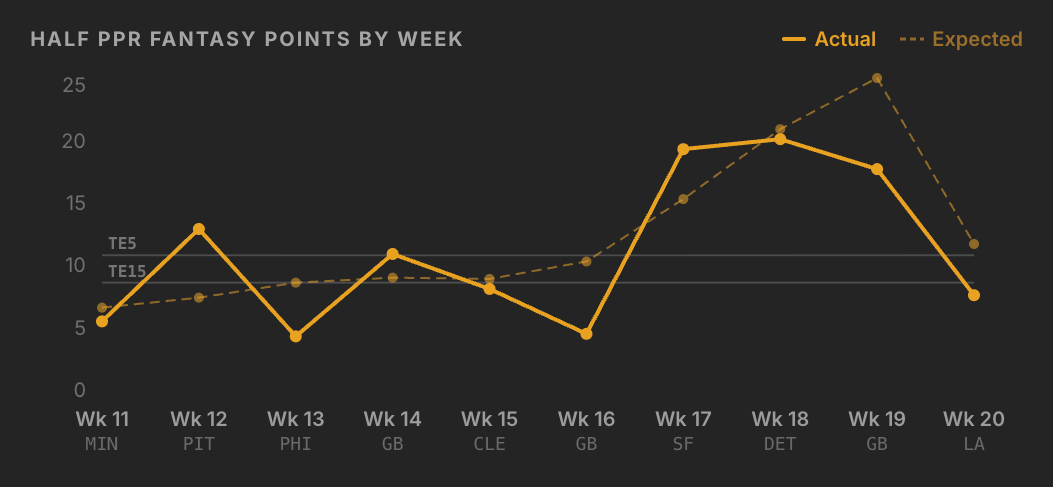
There’s nothing negative to say about Trey McBride himself. Echo all the points made about Loveland, except for the environment around him. McBride plays for the offense projected for the fewest amount of points and faces a potential third-round rookie QB for the final stretch of the season, after facing the most brutal opening schedule in the NFL. Unfortunately, there’s a ton of target competition, too. Marvin Harrison Jr. was out for a chunk of McBride’s insane finish last year. Michael Wilson emerged as someone worth featuring. And they added a do-all RB in Jeremiyah Love with the third overall pick. The OL makes me nervous, and I’m far less certain that new coach Mike LaFleur will repeat as the most pass-heavy offense in neutral situations.
Is McBride that much better than Loveland to overcome the six-point difference in projected points between the Bears and Cardinals on a per game basis? I’m not willing to find out.
4. Cam Skattebo (RB19 ADP) outscores Jeremiyah Love (RB13)
Love is clearly a better talent, but that’s not the goal here.
Fantasy football is about touches and touchdowns, and Skattebo is set up for them. Last year, Skattebo was the RB10 on RB12 usage in full PPR, while averaging 3.0 receptions per game and handling all 10 inside the five-yard line carries available to the backfield. I don’t see the Giants changing up the rotation much with the same backups behind him. It’s possible, if not likely, that Skattebo isn’t as efficient or doesn’t catch as many passes this year, but we’re talking about the RB9 per game as last year’s baseline.
These are the recent first-round rookies or the today’s elite RBs as rookies: Saquon Barkley (21.2 half PPR per game, RB2), Ezekiel Elliott (20.6, RB3), Alvin Kamara (17.4, RB4), Leonard Fournette (16.3, RB6), De’Von Achane (16.1, RB4), Jonathan Taylor (15.6, RB8), Najee Harris (15.5, RB8), Breece Hall (15.1, RB7), Jahmyr Gibbs (14.4, RB10), Josh Jacobs (13.9, RB13), Ashton Jeanty (12.8, RB15), Bijan Robinson (12.7, RB16), Kenneth Walker III (12.6, RB14), Clyde Edwards-Helaire (12.1, RB19), Omarion Hampton (12.0, RB18), Christian McCaffrey (11.8, RB12), Javonte Williams (10.8, RB22), Derrick Henry (6.6, RB53) and James Cook (5.9, RB55). The median outcome is RB13, but these backs weren’t on teams literally projected for the fewest points in the NFL, like the Cardinals are at 18.4. Right now, Arizona is projected to score more than 20.0 points in a game just twice this season. If the coaching staff is serious at all about Tyler Allgeier or James Conner on early downs, it’s hard to make the math work in late Round 2.
5. Jaylen Warren (RB28 ADP) outscores Bucky Irving (RB21)
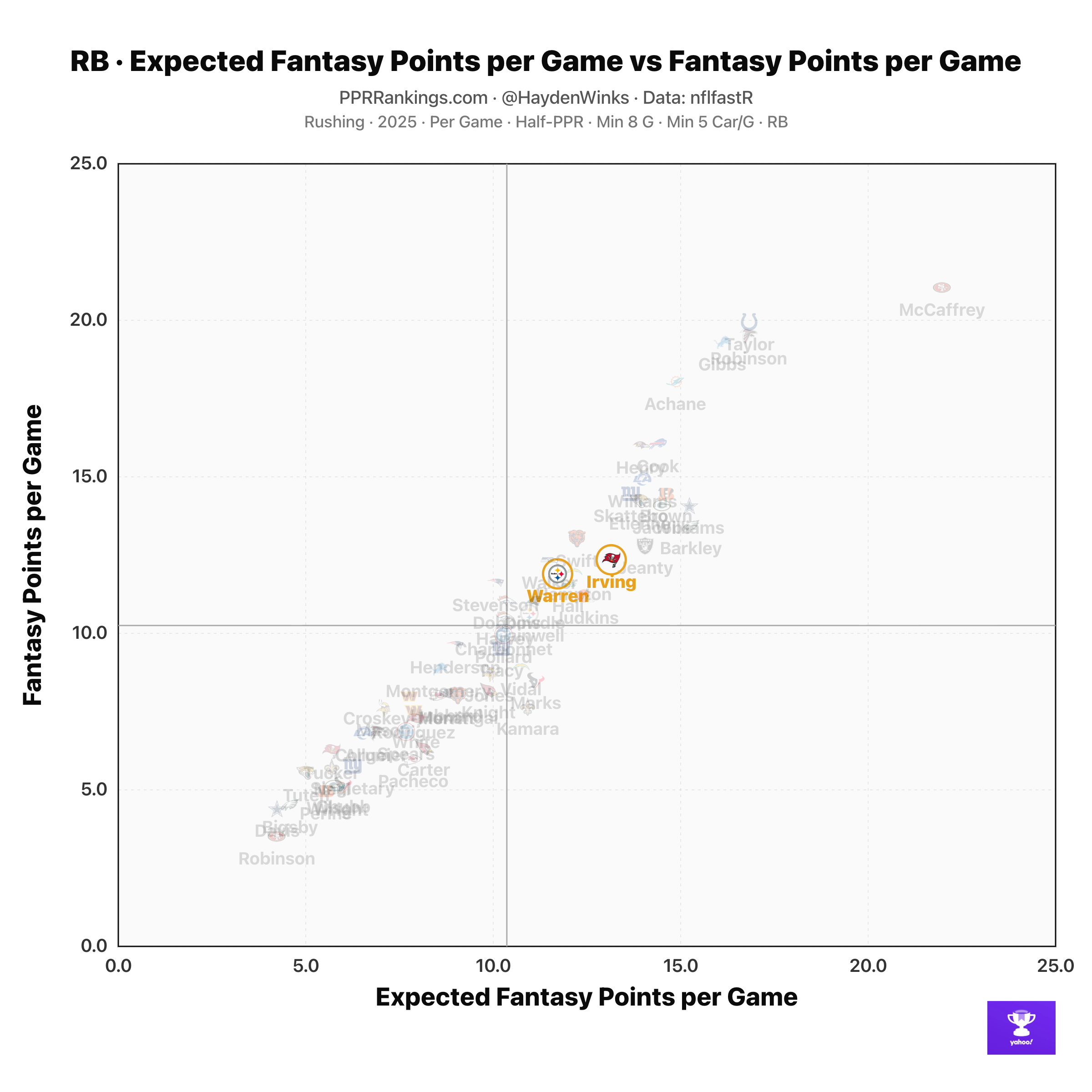
Warren was the RB20 per game on RB21 usage, while Gainwell PPR-scammed his way to a RB26 on RB25 per-game finish. They were essentially even in full PPR. I'm not sure how much there's to take from that split, aside from the Steelers proved to be stable across the OL and Aaron Rodgers has a history of using his RBs in the pass game. The Steelers were fourth in RB usage last year because Rodgers didn’t want to get hit and isn’t a threat at the goal line. Rico Dowdle could be too powerful to let Warren have those goal-line carries, but Warren is a better match for Rodgers and McCarthy’s traditionally pass-first offense. I also think he’s more talented while being the higher-paid incumbent.
Irving is coming off a disaster season and offseason shoulder surgery, and heads into a projected three-back committee backfield. Kenny Gainwell was paid too much ($10 million guaranteed) to not receive most of the backfield’s receiver work, and Irving ceded six-of-seven carries inside the five-yard line to the bigger Sean Tucker after returning in Week 13 last year. If Irving splits goal-line touches and doesn’t play passing downs, then how does he get home?
6. Kyle Pitts Sr. (TE8 ADP) finishes with 900+ yards again
We’ve seen Pitts healthy for two seasons, as a rookie and last year. In those two years, he’s averaging 57.5 yards per game, which equates to 977.5 yards over a 17-game season. Pitts just looked like one of the better moving tight ends again last season after multiple wasted injuries coming back from a full MCL tear. That’s not surprising to see multiple years later. We forget that Pitts was one of the freakiest prospects ever given his length and straight-line speed. Most TEs don’t hit their peak until they turn 25 years old (Pitts’ age) because this position requires a lot mentally. Without a proven No. 2 receiver behind Drake London, Pitts’ path to strong volume is probable, and my eyes and his end-of-year box score suggest he could be a real weapon again. The Kevin Stefanski offense has historically been TE-heavy, and Tua Tagovailoa is a willing and accurate thrower over the middle where Pitts operates.
7. Dallas Goedert (TE12) outscores George Kittle (TE9) and Travis Kelce (TE10)
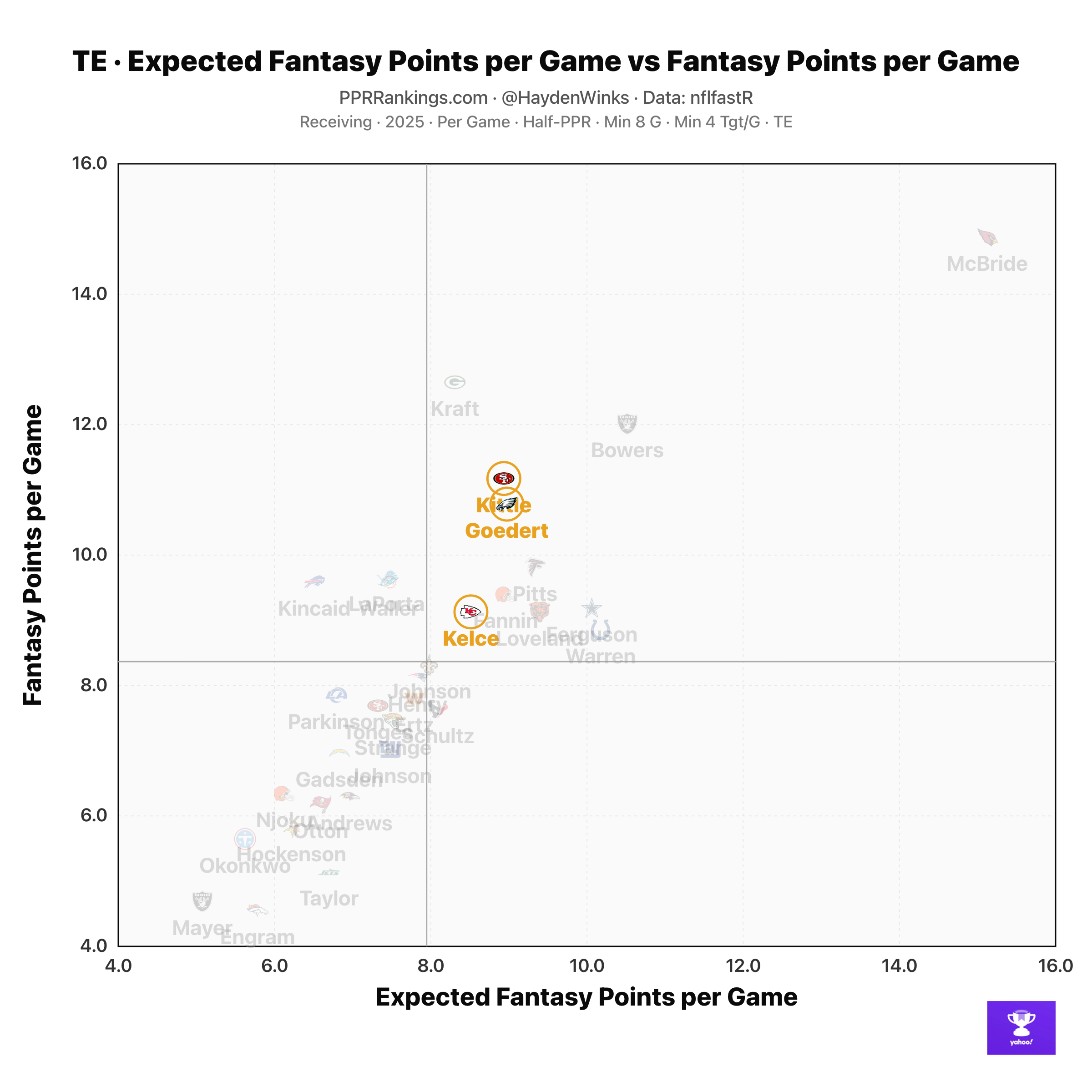
This isn’t 2022 anymore. All of these legacy tight ends are well out of their prime. Goedert and Kelce don’t move the same, and I’d be nervous about Kittle’s return this season after a Jan. 14 Achilles surgery, even if he still looked like a stud last year. In terms of team scoring, all are in good shape. The Eagles are 14th in projected points per the live betting markets, while the 49ers and Chiefs are seventh and 11th. The difference is just 1.2 points per game.
To me, Goedert has the best chance of seeing more volume in 2026 than last season of the three, and I’d project him to win a straight-line race based on his current health and tape from last season. The Eagles swapped A.J. Brown with Makai Lemon (hamstring), Eli Stowers (hamstring) and Dontayvion Wicks in the aggregate, but some of those looks will marginally trickle down to Goedert himself. Goedert can’t repeat the exact touchdown purity of last year (career-high 11 TDs), but they did allow him to touch the ball at the goal line on tush-push variants.
8. RB2s who will finish ahead of their RB1 teammates without injury: JK Dobbins, Rachaad White, Jordan Mason
These backfields are tossups with R.J. Harvey, Jacory Croskey-Merritt and Aaron Jones Sr. going earlier or within the same round of these drafted RB2s. Dobbins was the RB25 on RB29 usage through 10 weeks as the Broncos' clear top option, and in those weeks, Harvey was the RB36 on RB54 usage. The rookie was too volatile to trust, aside from fun manufactured scores around the red zone. When push came to shove, Dobbins was the relied upon starter. The selection of RB Jonah Coleman in the third round said more about Harvey’s inconsistency than Dobbins’ injury history. Coleman can play either role as a between-the-tackles rusher or pass protector.
Then there’s White, who has a clear-cut advantage in reliability over Bill. White is awesome in protection and as a check-down option on passing downs, and those skills are welcomed next to the petite Jayden Daniels. On film, Daniels is down-field to check-down often, and the Commanders don’t have great secondary options. White could be a real factor with receptions. Beyond that, he’s the more trusted between-the-tackles runner in short yardage. He’s a bit bigger and hits the hole with more decisiveness than Croskey-Merritt. We’ll see if the second-year pro can be too explosive to ignore. If not, the high-value touches lean White.
Aside from the Commanders, the cheapest backfield in fantasy is the Vikings. This is a pass-first team with an even committee, but this offense has a lot more upside than other committee backfields that are priced many rounds earlier. Mason’s hard-nose style and youth give him the advantage. He’s popping in the advanced rushing metrics still, including being the RB4 in yards per carry when not hit behind the line of scrimmage next to De’Von Achane, Jahmyr Gibbs, Derrick Henry and Kenneth Walker III. In four games without Jones from Weeks 3-7, Mason was the RB16 on RB24 usage in half PPR, while handling 63% of the carries. That’s probably close to his upside, but at an RB41 ADP on Yahoo, there’s a single or double to be had here.