

Fantasy Football: Here are some dos and don'ts to simplify your approach to drafting in 2026
I never liked playing chess growing up. It made me think too much. Having to plan out five moves ahead while contemplating my opponent's response or potential counters before even touching a piece made the whole idea sound less like a game. This was work! But once I learned the general rules and overarching strategies, I could understand the appeal.
Join or create a Yahoo Fantasy Football league for the 2026 NFL season
Drafting fantasy football teams can have the same vibe. It's organized chaos. You have a plan, and the fantasy gods laugh at you. The draft grades you receive afterward are enough to make you log out and forget you even joined a league before opening kickoff. Trust me, I've been there. And I still short-circuit sometimes when I'm on the clock. But after a few years of cobbling together winning teams, here are a few Dos and Don'ts to simplify things when trying to build a squad.
It's More About Profiles...Not Names
Admittedly, disregarding a player’s name and focusing on their production sounds exactly like something a nerd like myself would suggest. The thought runs counter to the excitement we experience every Thursday, Sunday and Monday. Specifically who touches the ball is what keeps us debating about this beautiful sport all the way until the next season starts.
The top 10 plays are here ‼️
— NFL (@NFL) February 21, 2026
Thoughts on No. 1? pic.twitter.com/fcDijcOd3b
On the one hand, the highlights and constant attention to offseason news and notes are what shape the market. Puka Nacua and Colston Loveland (featured in the top-10 plays) are two of the best at their position. We should value them accordingly. But the other side of that coin is the notion their production (not talent) is unique. In turn, if you don’t draft that particular player, you’ve fallen behind. However, you can find similar levels of opportunity elsewhere.
Round 1 (2021-2025): 28.2% (med. WR target %), 29.9% (med. RB touch %)
Round 2: 25.0%, 30.3%
Round 3: 19.5%, 26.9%
Round 4: 20.8%, 23.9%
Round 5: 20.7%, 23.0%
Round 6: 20.4%, 25.4%
I sampled the last five years of ADP and usage stats to see how the looks and totes have spread out over the early rounds. There are two takeaways here. One, the first couple of rounds are important! You’re likeliest to find players with the best chance at high-end workloads to kick off your draft. Second, and more important, the target and touch rates flatten out. In other words, we’ve got options should our plans (inevitably) go awry. Let’s look at a portion of the current WR ADP for an example.
Zay Flowers, BAL: 40.9 (ADP), WR17 (ADP Rank)
Ladd McConkey, LAC: 45.9, WR18
Jaylen Waddle, DEN: 46.3, WR19
The dizzying part for gamers coming into the ‘26 season cold is that they’ll have information overload and experience analysis paralysis.
“Zay Flowers is primed to break out with Lamar Jackson healthy.”
“Ladd McConkey in a Mike McDaniel offense? WR1 season loading.”
“Jaylen Waddle fits the type of offense Sean Payton and Bo Nix want to run in Denver.”
Each has valid paths to finding themselves inside the top 12 by season’s end. But their profiles to date emphasize why focusing less on the jersey becomes important. Sure, Flowers has earned more of his team’s targets since joining the league (25.5%), but both Flowers and Waddle are equally efficient with their touches (2.13 YPRR). Meanwhile, McConkey sits between the two in total end zone targets.
Here's where tiers become a drafter’s savior. A way to bucket groups of players of the same position into a single section. By doing so, you’re not only acknowledging the similarities between the subsets, but allowing yourself the flexibility to build around other players without damaging your prospects of taking down your league.
Opportunity Cost Comes for Us All
Let’s build on this concept of looking at player profiles instead of adhering to name value. As I said a bit ago, clustering free agents together gives you more options when your strategy backfires. But it also allows you to pay a lesser cost for comparable production. Take Brock Bowers’ 2026 outlook for example.
Brock Bowers pic.twitter.com/LA6SHzJq3S
— Ian Hartitz (@Ihartitz) July 21, 2026
The buildup to seeing a healthy Bowers back on the field is like watching ‘Lord of the Rings: The Return of the King.’ He’s got more competent QB play. And the offensive architect of the Seahawks’ Super Bowl win, Klint Kubiak, is his head coach. Bowers was just the fourth rookie TE to earn first-team All-Pro honors since 1960. No wonder he’s a second-round pick. But, again, let’s look at the profile of an elite tight end.
Team Target Rate: 0.83 (r value), 21.0% (median value)
First Downs per Route Run: 0.81, 9.5%
Yards per Route Run: 0.79, 1.79
I used the last five years of data to find out which metrics correlated to finishing as a top-three TE. Intuitively, hoarding targets and being efficient with them stood out. Of course, Bowers surpassed the thresholds for all three benchmarks in 2024. And with an improved situation, you can see why drafters prefer him as the TE1. But let’s look at the third-year ‘receiver’ another way.
Kenneth Walker III, KC, RB11
Nico Collins, HOU, WR9
George Pickens, DAL, WR10
A.J. Brown, NE, WR8
These are just a few examples, but all players drafted after Bowers. Said another way, here are the guys you won’t get. You’re trading the opportunity to add to your RB or WR stable for a TE. And the cost is an even-money bet. The TE1 has finished as the (equivalent) WR8 or better in four of the last five years. If you want a top-three TE, they just need to be a top-24 receiver. And Bowers is certainly capable of scoring more PPG than Luther Burden III. However, so are some other guys.
Tyler Warren, IND (Weeks 1-10): 52.7 (ADP), 21.3% (Target Rate), 9.9% (1D/RR), 2.04 (YPRR)
Tucker Kraft, GB (Weeks 1-7): 70.3, 20.6%, 11.2%, 2.49
Kyle Pitts Sr., ATL: 72.7, 22.7%, 9.5%, 1.72
Admittedly, Warren and Kraft come with injury caveats. The Colts might have cleared Daniel Jones for training camp, but that’s one bet in a multi-leg parlay for them to get back to their offensive dominance during the first half of ’25. And Kraft’s eight-game sample clashes with his absurd ability to create after the catch (9.0 YAC per reception). Regardless, combining profiles with draft price brings us another idea to consider. And it’s not just applicable to TEs.
Josh Allen’s rushing and passing acumen has made him a staple of the third round. But Jalen Hurts, available a few rounds later, rushed more often (17.8% QB rushing rate vs 17.1%) and scored more FPPG as a thrower than Allen (13.4 to 13.2). Tyler Shough and Brock Purdy, with scramble rates and passing efficiency, fall even further. In either case, by finding these arbitrage plays, you can add more strength to your roster elsewhere before focusing on the positions that only require a single weekly starter.
The Middle and Late Rounds Aren’t Just for Adding Depth
I’ve hinted at this throughout, but be sure to take your shots at WRs and RBs in the early stages of the draft. Yes, we’ve gone through ways to identify comparable players at lower prices. But with an early ADP comes some certainty.
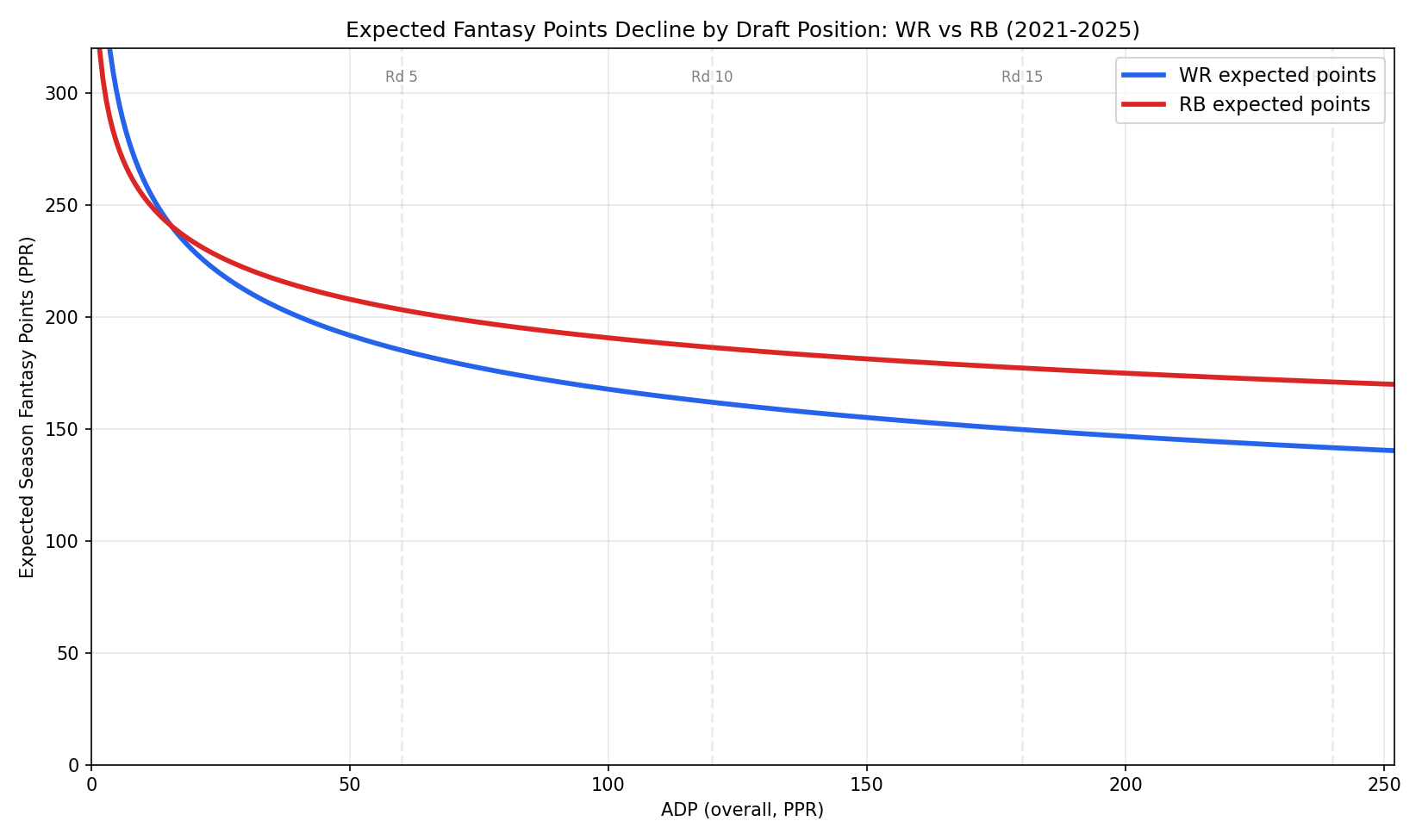
No surprise, but there’s a sharp decline in expected fantasy points at the core positions as we get farther into the draft. In short, we have a better sense of their projected workload or involvement within their respective passing games. However, where there’s uncertainty, it breeds an opportunity for savvy drafters to stock their starters and bench with high-upside players.
Rounds 7-10: 45.5% (WR hit rate), 41.7% (RB hit rate)
Rounds 11-14: 51.0%, 45.5%
Rounds 15-20: 41.5%, 54.0%
I looked at how often a receiver or rusher met or exceeded their draft cost. The larger takeaway is that we see hit rates rising as we get into the later rounds. On its face, the idea conflicts with our earlier premise. We’re paying for certainty along with our fantasy points. However, not every committee’s hierarchy remains permanent. The Steelers’ backfield from last year is one of many examples. But let’s look at the 2026 landscape to find a few worth monitoring with training camps underway.
Vikings: Aaron Jones – 113.2 (ADP), Jordan Mason - 123.5
Broncos: RJ Harvey – 87.8, J.K. Dobbins – 99.9
Commanders: Rachaad White – 113.2, Jacory Croskey-Merritt – 119.7
Steelers: Jaylen Warren – 81.3, Rico Dowdle – 89.7
Patriots: TreVeyon Henderson – 54.8, Rhamondre Stevenson – 89.0
The New England backfield should carry the most attention since the last time we saw the offense was in the Super Bowl. However, it was the weeks leading up to the final game that have me targeting the veteran over the sophomore rusher.
Rush Share: 67% (w/ Stevenson injured), 50% (w/ Stevenson back), 32% (playoffs)
Route Rate: 69%, 28%, 25%
Target Share: 13%, 6%, 8%
When the team stakes were at their peak, OC Josh McDaniels relied on Stevenson. Even when New England could’ve used a spark from Henderson to keep their championship hopes alive, the rookie played second fiddle as Seattle’s defense kept them at bay. And with Stevenson discussing his continued usage as a receiver, the gap in ADP between him and Henderson will be a gift for drafters willing to take the “RB2.”
Regardless, analogous situations exist across the league, even with WRs. The Jacksonville WR room will pay off for somebody (I’m stubborn and betting on Brian Thomas Jr.). We viewed Rome Odunze as a WR1 coming out of college, but Luther Burden III has that title for fantasy purposes. The list continues. But it’s our job as fantasy managers to sift through each to determine where the value lies.