

No, UNLV basketball isn't for sale. But is the idea really that far-fetched?
All weekend long, Josh Pastner's phone was ringing with unfamiliar numbers.
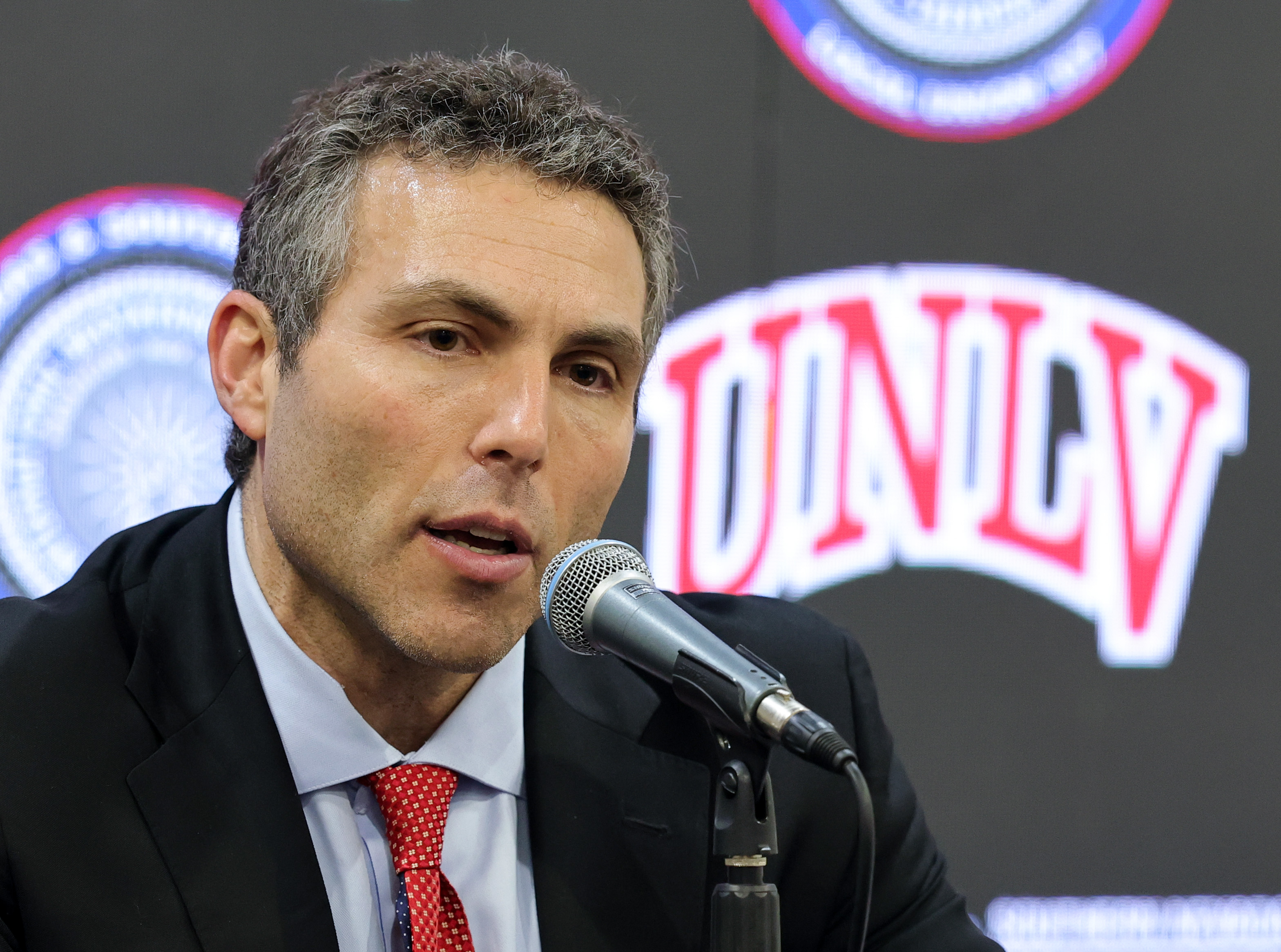
The UNLV men's basketball coach had gone viral on social media for an interview where he suggested that potential owners trying to buy an NBA expansion team in Las Vegas should instead "buy" Pastner's program for $10-12 million.
"You don't have to spend over a billion dollars to own our team," Pastner said. "You still get a great tax write-off and you can be as involved and you can tell everyone you're the owner of the team."
Almost immediately, the calls started coming in from people in far away states that Pastner had never met, from folks with no connection at all to UNLV. He wasn't even sure how they got his phone number.
But Pastner quickly realized something surprising: When he talked about the opportunity to "buy" the UNLV basketball team, the wealthy folks on the other end of the line were taking him literally.
"We're not for sale!" Pastner told Yahoo Sports. "I was saying it more, like, tongue-in-cheek. We need support, but we're really not for sale. The model's not set up for that."
Most of us who follow college sports closely understood what Pastner was trying to say. In the practically unregulated NIL era, where programs are spending as much on rosters as their donors are willing to give, it only takes one person with a wide open checkbook to become the de facto "owner" of a college team.
Just look at Texas Tech and the millions upon millions that mega-booster Cody Campbell has poured into NIL funding. No, he doesn't "own" the Red Raiders. But everyone understands he's the person most responsible for making them nationally competitive in football, men's basketball and softball. In terms of his influence on big-picture program decisions and being the public face of Texas Tech athletics, is there really any difference?
After some internal and external backlash to the way Pastner phrased it initially during the interview, he issued a clarification on Monday. But it was an interesting test case that illustrates, in some ways, why private equity/private capital has been circling college sports for so long.
Though UNLV is still an iconic brand name in men's basketball, the program hasn't been to the NCAA tournament since 2013, averaged only 5,374 in attendance last year and is part of a Mountain West Conference that has been significantly diminished by conference realignment.
It's a repair job. And there are few things private capital likes to invest in more than an undervalued, underperforming asset. If there was a financial model where an "owner" could potentially get a return on investment down the road, $10-12 million in UNLV basketball would look like a bargain.
"It's just a new day and age in college athletics," Pastner said. "Obviously teams can't be for sale. This is the students' team, the alumni's team, UNLV's team. No one can ever own the team. But it's interesting that it went viral. I just think that's the change in the landscape. Every program in the country is looking for ways to get more support financially."
Pastner is wrong about one thing. The idea of buying and selling college teams like pro franchises isn't that far-fetched anymore.
In a sense, it's already in motion. Utah finalized a nine-figure deal with Otro Capital earlier this year, forming a new company that will handle revenue-generating aspects of the athletic program. Michigan State just unveiled a new athletic department structure with $100 million in seed money, part of which is a for-profit subsidiary called Spartan Media Ventures where investors will get a return.
In early August, LSU is gathering donors at the governors' mansion for a "first look at an alternative revenue-generating opportunity for LSU athletics that is first of its kind nationally and could quite possibly change the future of college sports in America," according to the invitation. It's expected to include some type of structure where investors/donors could buy a "share" of a privatized athletic department.
Given the increasing cost pressures to compete now, it's not a huge leap to think a desperate school that just wants to win — but can't really afford it with its donor base — might actually be willing to "sell" its football or basketball program.
As the college sports structure evolves, it might even be beneficial for some schools if they could simply let investors fund the roster, pay the coaches and take on the profit/loss risk. In exchange, the school would get paid for use of facilities and trademarks to fund their other sports.
Is it radical? Sure. But just a handful of years ago, few in college athletics conceived of $50 million football rosters and basketball programs spending upwards of $15 million on players. Administrators have widely called that kind of spending "unsustainable," but instead of cutting budgets, they're looking for new and creative ways to fund their programs.
Who knows where it's all going to lead.
"Based on an article I read last week (in The Athletic), the coaches they interviewed said you've got to have $10 or $12 million just to have a chance to make the tournament," Pastner said. "We're not even in that galaxy. That type of money is bigger than football budgets were five years ago. So that's just the world we're in."
If UNLV is going to get into that realm, it won't be through a buyer. If a wealthy person out there just wants the perks and publicity (and the tax write-off) that would come along with the Runnin' Rebels getting back in the national conversation, Pastner — along with every coach in America — would love to have that conversation.
But if a school somehow did put their team up for sale, there'd be no shortage of buyers. The nonstop calls Pastner got over the weekend proves it.