
Fantasy Football: Identifying potential Year 3 breakouts from the 2024 WR class
We used to be a proper society. We used to have the patience for a third-year breakout WR in fantasy football, but our attention spans have eroded by way of Big Algorithm. Luckily for you, you are still reading in the Big 2026, which means you probably do have some patience remaining.
This column investigates the 2024 WR Class. There's a lot of promise with their tape, even if poor QB play, gunshot wounds, Travis Kelce clotheslines and torn ACLs have been in the way so far. I weigh their tape, their analytics and their environment before deciding who I'm ranking ahead or behind their current Yahoo ADP.
Join or create a Yahoo Fantasy Football league for the 2026 NFL season
Malik Nabers, WR, Giants (25th overall, WR11)
The consensus around Nabers' timeline is about Week 3. That's what ESPN's Jordan Raanan hinted towards, noting it could be Week 1 ,to a short stint on PUP in the worst-end outcome. Nabers made progress in July after not looking right in a celebrity softball game in the offseason.
He needed a cleanup procedure for a meniscus that was locking up, in addition to rehabbing his torn ACL. Multiple issues adds to the risk, but at the same time, Nabers is a 22-year-old world-class athlete, even amongst NFL players.
If he's out Weeks 1-3, for example, it’s not like you’re forced to get 0 fantasy points in your starting lineup. It should be easy to find replacements when the rest of the league is healthy, so we should only knock him so much if his absence is, in fact, short. Players like this aren't immediately themselves, but after a month or so, they often are 80-90%.
Nabers has as much potential as anyone outside of Round 1 from Week 5 on. He is PPR's WR6 on WR3 usage on a per-game basis since his rookie year in 2024. The Giants were 27th in scoring, 26th in passing yards, 27th in passing success rate and 30th in EPA per dropback over that span, and he's barely played with Jaxson Dart, who is on pace to be a solid starting QB after making things work as a rookie himself. New York is still only projected for the 22nd-most points per the betting markets, but it should be a tier above what Nabers' has been used to.
I'm buying the dip now that his ADP has settled past the third round. If we learn he's going to play in Week 1 or Week 2, then he'd be going next to A.J. Brown and George Pickens quite comfortably.
Ladd McConkey, WR, Chargers (40th overall, WR19)
McConkey busted as a sophomore after an excellent rookie season.
There were a couple reasons for this. One, McConkey was playing through an injury, while Justin Herbert was running for his life behind the most-injured OL in the NFL. Second, Herbert's catchable ball percentage on McConkey targets dropped from 78% to 67%, despite seeing the same level of screens. All of his per-target stats dropped significantly for reasons beyond McConkey himself. Last, the Chargers used him slightly differently, while Quentin Johnston took a material leap in his third season and Unc Keenan Allen did in fact "still have it." Ladd's downfield routes dropped by 5% in favor of more things underneath.
McConkey was also worse himself. His contested catch rate dropped from 57% to 3-of-14. He picked up less yards after the catch per reception. He straight-up didn't earn targets at the same rate on either slot or outside reps. The emerging super star that we saw late in his rookie season wasn't there.
So what about 2026? It's very easy to see a healthy OL, a healthier McConkey and a new coaching staff having him produce closer to his rookie season (WR14 per game) versus last year's WR39 per-game finish. All matter, but the one to analyze most is the presence of OC Mike McDaniel, who ran a very unique offense with the Dolphins. Since 2022, Tua Tagovailoa's had the highest play-action rate of dropbacks (27%). Over the past two years, Herbert's average depth of throw is way deeper (8.2) than what Tua's was (6.1) with McDaniel.
In offseason videos, Herbert's stance has changed to where in one step he can throw these quick-hitting routes. All of those tweaks play into the McConkey strengths in terms of agility and explosiveness. That's how Tyreek Hill and Jaylen Waddle exploded over the years with a QB less talented than Herbert. That's the upside if you're willing to buy into the bounce back.
The reasons for hesitancy in a loaded WR tier in Round 4 are McConkey's injury history at his size (6'0"/185) and the potential for lost routes with the Chargers four-deep at RB/FB, three-deep at TE and with the Tre' Harris blocking advantage at WR3. I wouldn't be surprised if McConkey is closer to 80% snaps instead of nearly 100% like others around him.
I have him as a Round 3-4 player in full-PPR and a firm Round 4 player in half-PPR as an upside WR2. That's the consensus on him.
Rome Odunze, WR, Bears (55th overall, WR28)
Odunze is clearly a great athlete for his size as an X or Z receiver. The Bears split his time across all receiver positions, even getting him in motion pre-snap to get him up to speed. A lot of his route were intermediate and deep types, rather than getting schemed up underneath where his more mediocre YAC ability doesn't stand out compared to Colston Loveland or Luther Burden III.
Odunze's role led him to being sixth-highest in average depth of target, yet 73rd in catchable ball rate out of 79 WR qualifiers since 2024. There were inaccurate passes from Caleb Williams far too often, and then Odunze's physical style led to some incomplete passes while in tough situations.
Odunze only mustered up a WR36 per-game sophomore season on WR18 usage and WR22 targets per game (7.1). That level of usage should be maintained while DJ Moore's trade leaves a pathway to nearly full-time snaps.
On tape, Odunze can absolutely improve his feel for zone coverage and timing with his QB, on top of obviously catching the ball cleaner. There were times he'd slow down coming out of a break, working through zone defenders or scramble drill that'd lead to incompletions. He also didn't come down with some tough grabs near the sideline or in traffic, ultimately leading to a forgettable 1.48 YPRR versus zone. Against man coverage, his 1.82 career yards per route sits amongst weekly fantasy starters. For his size, his ability to bend and explode out of the break was pretty, pretty nice.
The fully-formed version of Odunze is Tee Higgins, who routinely finishes his contested catches. Odunze is still 24 years old and has room for some imagination as long as his foot holds up. He's at least practicing through his injury early in the offseason and lots of NFL players play with weird feet without it being a headline.
There's a pathway for Caleb taking a real step in terms of consistency, and if that happens, Odunze could finish as a fantasy WR2 and the top target on the Bears. I'd still rank Loveland the highest in fantasy, but Odunze versus Burden is a real debate after watching their tapes for this project.
Brian Thomas Jr., WR, Jaguars (72nd, WR32)
Thomas completely flopped in his second season, to everyone's surprise. Some of it can be explained by a "nagging" wrist injury, which occurred when working over the middle in the second preseason game.
But there were scheme fit issues on top of simply not catching the ball cleanly. Thomas is an awesome speed-based outside receiver, who also generated explosives on some underneath reps as a rookie. He was electric against man coverage in his debut, then caught eight passes against man coverage in 2025. His screen rate fell from 11% to 1%, and he averaged 3.5 targets within 5.0 air yards as a rookie to just 1.3 last year. All that equated to WR37 usage in 2025 versus WR19 usage as a rookie.
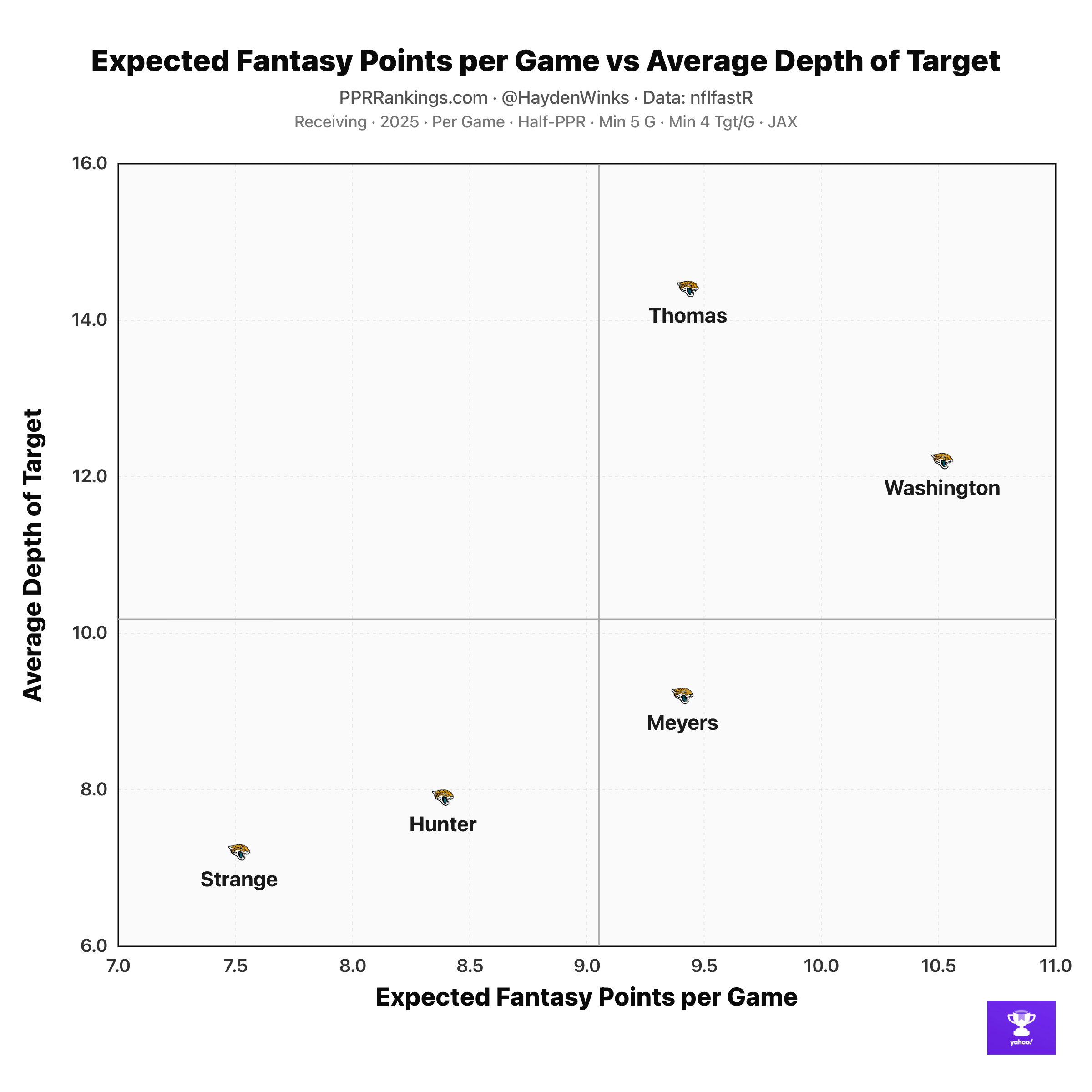
The lack of layup targets is unfortunately explained by the Parker Washington breakout, the Jakobi Meyers trade and the quarter season of Travis Hunter mixing in. None of that has changed heading into 2026. Our baseline should be Thomas is the vertical receiver without a weekly floor. It's possible that with better health or with injuries to teammates that he becomes the more well-rounded receiver we saw when he was the WR3 on WR4 overall usage from Week 13 on during his rookie year, but that is pure speculation and upside.
Jacksonville also added a second-round TE and the staff has mentioned being multiple in terms of personnel, so it's possible Thomas is not a full-time player. That'd be especially true if Hunter plays more WR than expected, though it seems like he'll be a near full-time CB while playing about 20% snaps on offense depending on health and matchup.
Overall, I'm taking Thomas's WR37 usage from last year at face value and viewing him just ahead of that in half-PPR. I know he's a better receiver than what he showed last year, but I also know things have changed from his rookie year in terms of teammate strengths. For Thomas to take the next leap on tape, he has to catch the ball cleanly over the middle (obviously) and then work on his salesmanship when facing off coverage. He can show his cards when working the comeback or breaking routes by coming too upright, and there were too few reps of making CBs play on skates. So far, almost all of his big plays are purely because he's big (6'2"/209) while playing with 4.3 rockets.
Marvin Harrison Jr., WR, Cardinals (73rd overall, WR33)
Harrison has been as disappointing on tape as he's been in fantasy football after having the most pre-draft hype of any WR in years. He's a good, not great, NFL starter right now, though that's coming in the most difficult role there is.
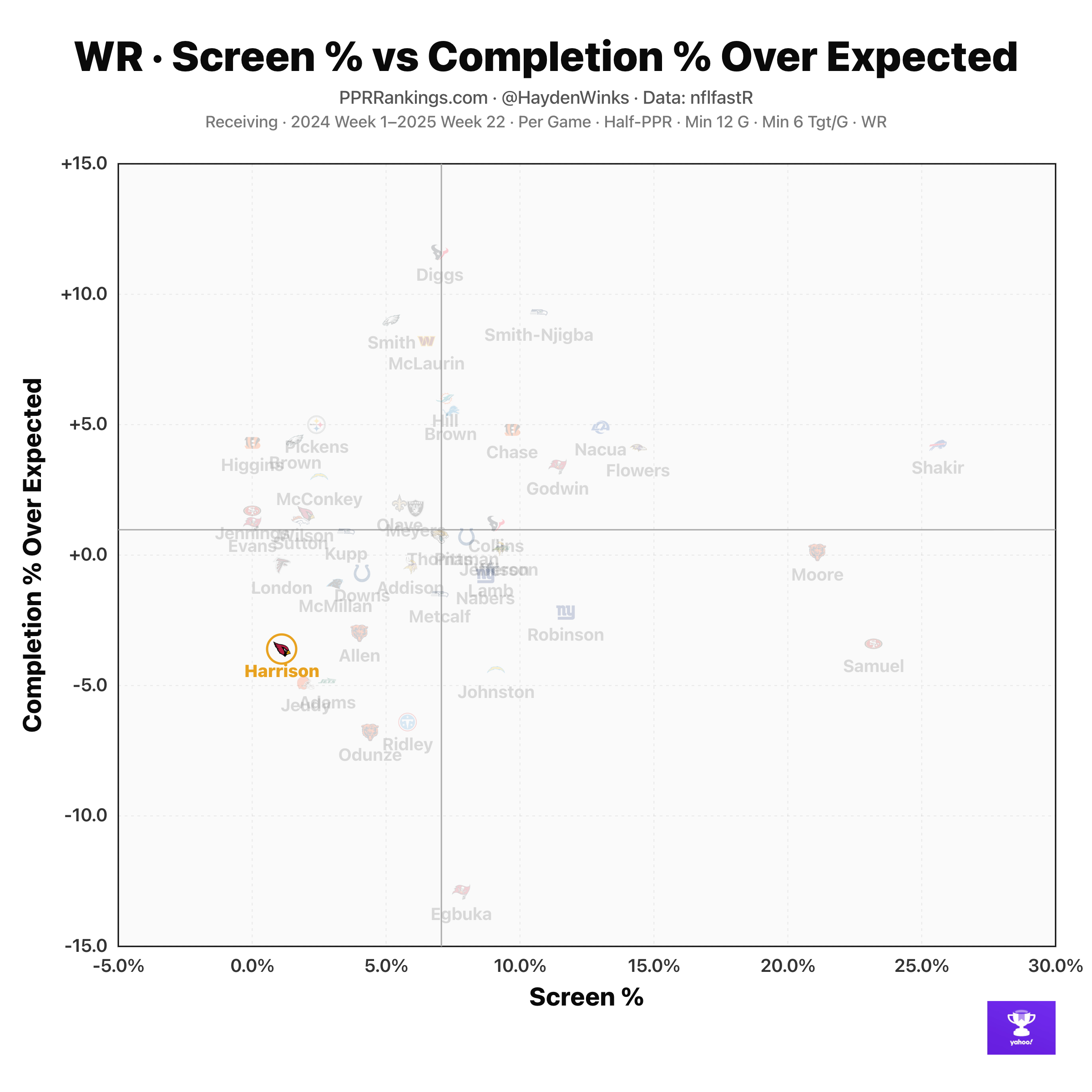
Harrison has a career 1.1% screen rate, and he was lining up on the line of scrimmage in a static way on a large majority of his snaps. He was rarely put in motion or thrown passes that'd lead to more YAC. That likely changes to some extent with new head coach Mike LaFleur, but some of that is because Harrison isn't a nimble athlete with short-yardage burst. That hurts his weekly consistency.
Fortunately, Harrison did show a little more speed on tape in 2025, enough to threaten vertically and when coming out of breaks on those in-cuts on intermediate passes. That's his best trait right now, and one that can be very valuable with the right QB. But it's fair to question if he has the right QB in 2026.
Unfortunately, Harrison's untimely drops make a pretty strong lowlights tape, and there were as many near catches in traffic or near the sideline as there were just blatant drops in open space. I can't explain why he's regressed so harshly since his college days in these areas, but it's what has prevented him from being an above-average outside receiver through his age-22 season. This type of thing tends to work itself out, however, but it's one of the most shocking things of the last couple seasons.
Play Yahoo's new College Fantasy Football game: Create or join a league now!
In his first two seasons, Harrison is the WR42 on WR40 usage on a per-game basis. Last year's finish was actually slightly worse than it was as a rookie after Michael Wilson and Trey McBride each took a leap. Neither of those players are going anywhere, and both have been more effective underneath. Throw in the Cardinals' third-overall pick in RB Jeremiyah Love, and all of a sudden there is a lot more skill talent than QB talent. If Jacoby Brissett is benched after a brutal opening schedule (@LAC, SEA, @SF, @NYG, DET, @LAR, DEN, DAL, @SEA, LAR, and @KC), we're in for a third-round rookie in Carson Beck for the fantasy playoffs.
Harrison's real-life value is tiers above what we can expect in fantasy football for those reasons, even if I appreciated his sophomore tape a bit more than I did as a rookie. Harrison looks like an inconsistent WR4 in fantasy who will be difficult to nail down every week.
Ricky Pearsall, WR, 49ers (78th overall, WR34)
Pearsall was shot and dealt with a nagging PCL injury to his knee in his first two seasons. It's a terrible run out so far, but when he's at full speed, Pearsall can move pretty well on these crossing and deep out routes. That's where he's been at his best so far.
Pearsall does a nice job working against off coverage where he can decelerate and break quickly on these play-action dropbacks. There seems to be a ton of open grass on Pearsall's side of the field, and Brock Purdy is willing to layer passes to the sideline repeatedly. The addition of Mike Evans should solidify this Pearsall role as an intermediate and sideline-based player, while the future Hall of Famer will work vertically and on dig routes with his frame advantage.
That said, Evans has an injury history and age working against him. Ditto for George Kittle and Christian McCaffrey. When everyone is healthy, it wouldn't be overly surprising if he barely cleared the 5.1 targets per game he had last season, but when even one of them is sidelined, Pearsall does have the skill set to be a higher-volume player for a stretch. I do worry about his size and own injury history, just as I do with the McConkey, Rashid Shaheed, Jordan Addison and Jameson Williams type of players he's most similar to, but there is a very clear path to him hitting as a sleeper.
Where Pearsall is limited is playing with physicality and short-area wiggle. To combine the two, Pearsall has broken zero (0) tackles throughout his career, per PFF. I haven't noticed one either. McConkey is a tier above, to me, because he has that elite start-stop ability that Slick Rick only has at 80%. That probably plays into why he's only had five screens through 20 games and why his average depth of target is 12.6 yards downfield.
Ultimately, Pearsall feels like a big hit, small miss player in this 49ers' aging offense. A floor was established last year while playing on 1.5 legs, as the WR55 on WR55 usage. He didn't score a touchdown all year but did average 10.0 YPT. That is an outstanding mark.
Xavier Worthy, WR, Chiefs (90th overall, WR41)
Worthy's sophomore season was a total bust, but how much of that can be contextualized with random injuries is the question. He suffered a dislocated shoulder from Travis Kelce in Week 1, played through it and then had surgery immediately following the season. He also picked up an ankle injury in Week 5, then had a setback in Week 13 on it.
Coach Andy Reid said: "I would tell you that we kind of, after that, we were afraid to do certain things with (Worthy). So I think him coming back healthy, I think opens up that whole picture you saw during training camp, where he had a whole bunch of different routes in there." My interpretation of that is some of the underneath work that Rashee Rice (knee/jail) and Kelce (old) could flow to Worthy in 2026, too. The data backs this up. His average depth of target increased from 8.9 yards to 12.9. His screen targets per game dropped from 1.2 to 0.5, too. Reid also specifically mentioned they limited his crossing routes in 2025, and that's an excellent route for Worthy to showcase his speed.
Worthy will always be a deep threat with his record-breaking speed, but he can't be the WR55 in targets and be a fantasy starter. An increase in targets is possible, whether it's from the Reid statement, Kelce falling completely off in his age-37 season or if Rice has a setback on or off the field. It's still possible, even if unlikely, that Rice gets a modest suspension for violating his plea deal and making the NFL look bad.
On tape, Worthy clearly had issues last year. His size provides obvious problems, but last year, he simply wasn't moving at an elite pace in a straight line and especially coming out of his breaks. Worthy did that some in college and as a rookie, so a bounce back is expected if he is actually healthy coming into training camp. At the same time, his work against press coverage isn't good enough. His size obviously works against him, so it's harder for him to get into a spot where he can break on time. He did it a few times against the Texans in Week 14, but those wins came too inconsistently. That on-the-line-of-scrimmage role has been thrust onto him because Rice doesn't win outside and Tyquan Thornton is just as skinny.
Worthy was full-PPR's WR27 on WR33 usage as a rookie (without Rice) before collapsing to WR59 on WR51 usage in 2025. I'm buying him as the WR44 right now.
Jalen Coker, WR, Panthers (106th overall, WR47)
Including the playoff game when he played 89% of the snaps, Coker is averaging 9.45 half-PPR points when he's cleared 66% of snaps in a contest. That would've made him the WR34 last season. Unfortunately, he's run really, really hot on his targets in this limited sample, most notably having a zillion-yard TD on a busted coverage. His YPT in these near full-time games sits at an elite 9.7 yards. That's a good thing, but it makes sustaining this FLEX level trend harder.
Coker's emergence is great news for the Panthers. He can play a big slot role or hold his own as an outside receiver, which allows Tetairoa McMillan to cook as a big slot himself. Carolina has said it wants to get T-Mac inside more. Smart, as McMillan and Drake London are twins (and London is awesome in the slot). Coker can play either spot because he is tough over the middle and is a polished route runner. There isn't much fat to his game, and he has a nice catch radius on horizontal routes. His speed definitely clears the bar, even if he's not a world-class athlete — his vertical was 42.5" for crying out loud.
In an up-and-down role last year, Coker averaged as the WR49 on WR67 usage. That feels pretty close to his floor, as he only played 67% of the Panthers snaps when he was active. That has to clear 85% this year based on their roster, just as it had in their near upset win in the playoffs when Coker shredded the Rams for 9-134-1 on 12 targets.
Coker's well-rounded skill set has me confident in him being the Panthers’ No. 2 target in 2026, which is the threshold required to be a real fantasy football sleeper. Carolina's OL looks worrisome and I still don't fully trust Bryce Young's play, but in deeper leagues, Coker is absolutely worth drafting in the double-digit rounds. If McMillan goes down, I think he'd be a WR3/flex play. His tape backs that up.